Friday, November 23, 2012

Religion as a battering ram / Vayishlach

Whether or not Dinah is kidnapped, whether or not she is in love with Shechem, and whether or not Shechem truly loves her after raping her, one thing is uncontested: the sons of Jacob use the sacred covenantal rite of circumcision as a weapon of slaughter. When Shechem and his father Hamor come to ask permission for Shechem to marry Dinah:

Jacob’s sons answered Shechem and his father Hamor, speaking with guile because he had defiled their sister Dinah, and said to them, “We cannot do this thing, to give our sister to a man who is uncircumcised, for that is a disgrace among us. Only on this condition will we agree with you; that you will become like us in that every male among you is circumcised. Then we will give our daughters to you and take your daughters to ourselves; and we will dwell among you and become as one kindred. But if you will not listen to us and become circumcised, we will take our daughter and go. (Genesis 34:13-17)

They speak b’mirmah (with guile). We shouldn’t be as shocked as we are when we learn that the purpose of the scheme — at least in the minds of Shimon and Levi — is not to merge two peoples, but to weaken the Shechemites. But we are most certainly appalled when we learn that while the Shechemites are healing and most vulnerable, on the third day after their circumcisions, Shimon and Levi enter the city with drawn swords. They slaughter all the males and more:

They put Hamor and his son Shechem to the sword, took Dinah out of Shechem’s house, and went away. The other sons of Jacob came upon the slain and plundered the town, because their sister had been defiled. (Genesis 34:26-27)

Torah emphasizes that the purpose of the horrific butchery is to free Dinah and avenge her rape. (And let’s not overlook that they then plundered the town.) Could they not have recovered Dinah in any other way? How could they possibly justify killing every male to free their sister? How did they manage to execute this plan without Jacob having a hint of it? And if Jacob knew, why did he not intervene?

Beneath these troubling questions is yet one more: What are we to make of the use of a sacred Jewish rite — brit milah — as a means to weakening people so they can be overpowered and killed?
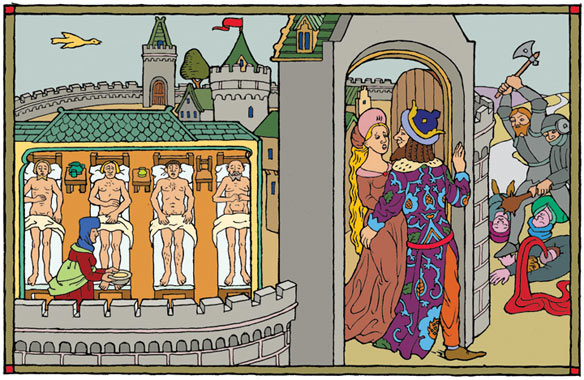

There is no shortage of people who claim that religion does this all the time, and they have no difficulty marshaling evidence:

Historically, the Church used its teachings about heaven, sin, and salvation to control great numbers of people and threaten them with eternity in the fires of hell, as well as to justify countless massacres, the Inquisition, and witch hunts. Today “sacred Christian values” are evoked to coerce public policies and laws that violate other people’s values and rights (specifically contraception and reproductive rights).

Islamic teachings from the Qur’an have often been used to relegate non-Muslims in Muslim countries to second-class citizenship (dhimmi). In our time, sacred religious texts and promulgations of imans have provided both motivation and justification for horrific terrorism.

In Judaism, threats of God withholding the fullness of olam haba (the world-to-come) have been used to coerce people into observing Judaism in a manner a select few deem correct and defaming other streams of Judaism, which keeps them in the seat of power, at least in their communities. Sacred text has been used by “Settlers” in Israel to justify murder and the destruction of mosques.

This is not to say that all Christians, Muslims, and Jews engage in such behavior. In fact, it is a small minority. But it a shameful thing to do.

Jacob’s response to the massacre his sons have wrought is distressing and disheartening.

Jacob said to Shimon and Levi, “You have brought trouble on me, making me odious among the inhabitants of the land, the Canaanites and the Perizzites; my men are few in number, so that if they unite against me and attack me, I and my house will be destroyed.” (Genesis 34:30)

Where is Jacob’s moral condemnation? Jacob’s only concern is for himself, and he couches everything that way: “me,” “my men,” “attack me,” “I and my house.” This is not the model we would hope for. Lacking that, we must be the models out in the world who call our co-religionists to a higher level of accountability, and reject their use of sacred texts, rites, and traditions as weapons to attack — within the Jewish community and beyond it, as well.

© Rabbi Amy Scheinerman

Sunday, November 18, 2012

Jacob's Zen / Parshat Vayeitzei

A Zen master visiting New York City goes up to a hot dog vendor and says, "Make me one with everything." The hot dog vendor fixes a hot dog and hands it to the Zen master, who pays with a $20 bill. The vendor puts the bill in the cash box and closes it. "Excuse me, but where is my change?" asks the Zen master. The vendor replies, "Change must come from within."

The account of Jacob’s ladder in this week’s parashah has much to teach us about our own lives.

Jacob left Beersheba and set out for Haran. He came upon a certain place and stopped there for the night, for the sun had set. Taking one of the stones of that place, he put it under his head and lay down in that place. He had a dream; a stairway was set on the ground and its top reached to the sky, and angels of God were going up and down on it. And Adonai was standing beside him, and God said, “I am Adonai, the God of your father Abraham and the God of Isaac. The ground on which you are lying I will give to you and to your offspring. Your descendants shall be as the dust of the earth; you shall spread out to the west and to the east, to the north and to the south. All the families of the earth shall bless themselves by you and your descendants. Remember, I am with you: I will protect you wherever you go and will bring you back to this land. I will not leave you until I have done what I have promised you.” Jacob awoke from his sleep and said, “Surely Adonai is present in this place, and I did not know it!” (Genesis 28:10–16)

Jacob's Ladder by William Blake (British Museum, London)

Jacob is on the lam. He cheated his brother, deceived his father, and stole the patriarchal blessing. He has every reason to think Esau will come after him to kill him. He is fragile and vulnerable. His life, recently so privileged and cushy, now lacks all luxuries. His security, recently so assured, is now up in the air. Jacob ventures into a new land, a new family, a new culture. Jacob has reached the outer borders of his life and is about to cross that boundary into… who knows where? Va’yifga ba-makom  (“he came to a certain place”) — a nowhere place without a name. Ki va ha-shemesh (“the sun is setting”) — it’s neither day nor night. Jacob lies down and dreams a dream so vivid it’s not clear whether he is conscious or unconscious. Jacob is in limbo: physically, temporally, and spiritually betwixt and between.


Jacob awakes to a revelation:  Achein yesh Adonai ba-makom ha-zeh v’anochi lo yadati (“Surely Adonai is present in this place, and I did not know it!”) Jacob’s neshamah (his soul, or inner self) has finally been awakened.
            
 I want to share a Hasidic interpretation of Jacob’s spiritual awakening.  At the very moment that Jacob becomes aware of God’s presence (“Surely Adonai is in this place”) he comes to the realization that v’anochi lo yadati, which can be translated, “I did not know me/myself.” Only when Jacob sheds his considerable ego, jettisoning his anger, fear, deceit, self-justification, sense of entitlement, is there room for God’s presence “in this place.” To make room for God we need to surrender our self-centeredness and open ourselves up — truly open ourselves up — to God. Our narrow concerns crowd God from view.
            
 This interpretation comes from the world of Hasidut, which is richly informed by Kabbalah (Jewish mystical tradition). While I am not a mystic, I believe there is much wisdom to be gleaned in the way mystics view the world and think about God and humanity. This interpretation teaches me three important things:
             
First, the God inside me is the God inside you, the God inside Jacob, the God that is not only in “this place” (as Jacob said) but is the place of the universe. The Rabbis, in midrash Bereishit Rabbah 68:9 express it this way: God is the dwelling place of the world, but the world is not God’s dwelling place. God is in everything and also beyond it. This is a God-saturated world. By way of analogy, consider radio waves, the electromagnetic part of the light spectrum. Vibrating radio waves travel at the speed of light. They’re everywhere, surrounding and even penetrating you. But they can be only be detected and decoded with a radio receiver that is tuned to the right frequency. In a similar way, God is within and around us all the time, but we have to set our receivers to become aware, tuned in. You are a natural receiver if you tune in. So what we need to do is stop. Clear our minds. Tune our spiritual receivers. It begins with mindfulness. This is what prayer and Torah study are about.
            
 The second thing this interpretation teaches follows from the first: God is not up there, out there, far away and distant, separate from the universe I know and inhabit. (That’s the picture of God presented me as a child, but it’s not the reality I live.) I cannot find God “out there.” I can only find God through conventional prayers, sacred texts, and religious practices when I use those prayers, texts, and practices to face myself, to know myself, and to remake myself; then I can explore what it means to be fully human, find my purpose in life, and learn how to be God’s image in the world. That’s what Jacob is finally doing. In this God-saturated universe, Jacob is tuning his receiver to God and facing his true self.
            
 The third thing I learn from the interpretation is about how the world works. Rather than expecting that a God “out there” will intervene in the world on my behalf, I need to focus on the God within — deep within. That means that God works in the world not by big splashy miracles, but through me, and you, and everyone else. And since that’s how God works in the world, it must be the case that I — just like Jacob, just like you — have everything I need within me to become what I should be become. The solutions aren’t “out there” and I can’t blame “them” (parents, teachers, economy, politics) when I don’t realize my potential. I must dig deep within. That’s where change and transformation are born and blossom.
             
As it turns out, in a sense all of us are always in limbo — always betwixt what we are, and between what we might yet be. We are always changing, becoming. And given that, as the Greek philosopher Heraclitus said, change is the one constant of the universe, we do well to consciously and purposefully embrace and manage our personal evolution.

Okay, let’s hear it again: A Zen master visiting New York City goes up to a hot dog vendor and says, "Make me one with everything." The hot dog vendor fixes a hot dog and hands it to the Zen master, who pays with a $20 bill. The vendor puts the bill in the cash box and closes it. "Excuse me, but where is my change?" asks the Zen master. The vendor replies, "Change must come from within."

Jacob is our model. He dives within to find himself and thereby find God. He is not wholly transformed overnight — concrete change takes more than two decades — but Jacob is continuously evolving, always becoming.  Like Jacob, we too can dive within and there find God, our true selves, and our divine potential.

© Rabbi Amy Scheinerman

Monday, November 12, 2012

I can delay gratitification - if I get it now! / Parshat Toldot

Have you heard of the marshmallow experiment? In 1972, Stanford University psychologist Walter Mischel constructed an experiment to determine the mental processes that enable us to delay gratification. Six hundred fifty-three 4- and 6-year-olds were offered a marshmallow. They could eat it immediately, but if they waited for a time, they would be rewarded with a second sweet treat. Can young children resist temptation in the short term to gain a reward in the long term? Consider for a moment if Esau were one of Mischel’s test subjects.


Once when Jacob was cooking a stew, Esau came in from the open, famished. And Esau said to Jacob, “Give me some of that red stuff to gulp down, for I am famished” — which is why he was named Edom. Jacob said, “First sell me your birthright.” And Esau said, “I am at the point of death, so of what use is my birthright to me?” But Jacob said, “Swear to me first.” So he swore to him, and sold his birthright to Jacob. Jacob then gave Esau bread and lentil stew; he ate and drank, and he rose and went away. Thus did Esau spurn the birthright.

Esau cannot defer gratification. We can criticize Jacob for taking advantage of his vulnerable brother. I have no argument with that, but I want to focus on Esau’s choice, without become entangled in Jacob’s arguably unethical behavior.

We might claim that Esau is famished. As hungry as he is — after only one day out hunting, a day that probably began with breakfast — he is hardly on the verge of collapse, or suffering malnutrition. What is more, the stakes are extraordinarily high: the birthright itself, something that has long term consequences.

We are all faced with choices like Esau’s. As teenagers we decide how much time and energy to invest in our social lives and how much to invest in our studies. As adults we decide how much of our resources to spend on the pleasures of life, and how much to invest for retirement. Short term gain versus long term investment. Our decisions — for the short term or for the long term — are often a crucial determining factor in future opportunities, careers, relationships, and retirement.

Does this mean we should always defer gratification and never indulge in the pleasures of life? Certainly not!

R. Chizkiyah said in the name of Rav: You will one day give reckoning for everything your eyes saw that, although permissible, you did not enjoy. (Jerusalem Talmud Kiddushin 4:12)

What R. Chizkiyah means is that God has given us a world filled with pleasures and wonders. God wants us to enjoy them and be happy because life is a divine gift to be savored. In fact, we express our gratitude to God by enjoying the blessings and pleasures of life. Being present in the moment, enjoying the wonder of life, and appreciating our blessings is a Jewish religious value.

If we forgo the pleasures of life -- always setting them aside for the future -- when will there ever be a time that is a “present” in which we need not defer to the future?
The Rabbis frowned on asceticism precisely because asceticism is grounded in a denial of pleasure. My husband’s grandmother always took the gifts her husband received — new shirts, razors, and the rest — and “put them away” for his “old age.” She was still doing this when he turned 90. When do we unwrap our gifts and savor their beauty?

Talmud tells us that when the Rabbis left the school of Ammi, they blessed one another:

May you see your world in your lifetime, and may your latter end be for the future world and your hope for many generations; may your heart meditate understanding, your mouth speak wisdom and your tongue compose song…

What a magnificent blessing! May you see your world in your lifetime  — may we all see our dreams and visions realized in our lifetime. For that to happen, we need to unwrap the gifts today. May your latter end be for the future world — but if we live only for today, without thought to the future, we will not have a “future world.” We need balance in order to maintain an appreciation of the present that nurtures [our] hope for many generations.

Perhaps the best description of the Jewish approach to achieving a healthy balance is encapsulated in the words of an exceptional sprightly and vigorous elderly woman who visited the first year Harvard University medical school class a few years back to speak about her experience with health and medicine. One student asked what her secret was to being so healthy, fit, and active at such an advanced age. She smiled and responded, “My rule is moderation in all things, including moderation.”

© Rabbi Amy Scheinerman

Monday, October 29, 2012

In the blink of an eye / Parshat Chayei Sarah

How many times have you heard someone say, “it was love at first sight”? Perhaps you have used this phrase to describe your relationship with your partner. If, as Jane Austen describes in Pride and Prejudice, there can be hate at first sight could there not be love at first sight? Yet can a person truly gather enough information to formulate a solid, rational judgment -- let alone fall genuinely in love -- in the blink of an eye?

Eliezer, Abraham’s loyal and resourceful servant, travels to Haran to secure a wife for Isaac from among the clan of Abraham. When he arrives in Nahor and stops to water the camels, he prays:

O Lord, God of my master Abraham, grant me good fortune this day, and deal graciously with my master Abraham: Here I stand by the spring as the daughters of the townsmen come out to draw water; let the maiden to whom say, “Please, lower your jar that I may drink” and who replies, “Drink, and I will also water your camels” -- let her be the one whom You have decreed for Your servant Isaac. Thereby shall I know that You have dealt graciously with my master. (Genesis 24:12-14)

What’s this about? Is Eliezer expecting God to send the right woman along at just this time? Is he expecting God to signal him in some way that a certain woman is the right choice? Cue Rebekah, stage right:

He had scarcely finished speaking, when Rebekah, who was born to Bethuel, the son of Micah the wife of Abraham’s brother Nahor, came out with her jar on her shoulder. The maiden was very beautiful, a virgin whom no man had known. She went down to the spring, filled her jar, and came up. The servant ran toward her and said, “Please let me sip a little water from your jar.” “Drink, my lord,” she said, and she quickly lowered her jar upon her hand and let him drink. When she had let him drink his fill, she said, “I will also draw for your camels, until they finish drinking.” Quickly emptying her jar into the trough, she ran back to the well to draw, and she drew for all his camels. (Genesis 24:15-20)

Eliezer may pray for a sign, but he makes his decision by means of a character test. Rebekah is the hands-down winner. This young woman is gracious, kind, generous, and hospitable -- to both people and animals. She is also hardworking and strong; the spring is not far from the trough, but Rebekah still has to schlep sufficient water for ten camels from well to trough. Who wouldn’t want this woman as a wife or daughter-in-law?

Does Rebekah recognize that Eliezer brings gifts of great value? He does have ten camels, but he isn’t dressed like royalty and she might well presume him to be a merchant, if she gives it any thought. We know that her brother Laban sure notices -- immediately. Torah suggests that Laban focuses on the nose-ring and bracelets Eliezer has given Rebekah before he bothers to look at the visitor from afar.

It is said that “first impressions” are the most important, and that you never get a second chance to make a first impression. Presumably our amygdala (the more primitive part of our brain that is responsible for the “fight or flight” response) hijacks the evaluation process, rendering a mental image of the person we have just met before the neo-cortex can conduct a more measured analysis. But Malcolm Gladwell, in Blink: The Power of Thinking Without Thinking tells us that while first impressions are arrived at in no more than two seconds -- the blink of an eye -- they should not be undervalued: “There can be as much value in the blink of an eye as in months of rational analysis.” He explains:

“We live in a world that assumes that the quality of a decision is directly related to the time and effort that went into making it...We believe that we are always better off gathering as much information as possible and spending as much time as possible in deliberation. We really only trust conscious decision making. But there are moments, particularly in times of stress, when haste does not make waste, when our snap judgments and first impressions can offer a much better means of making sense of the world. The first task of Blink is to convince you of a simple fact: decisions made very quickly can be every bit as good as decisions made cautiously and deliberately.”

That should reassure us. Our snap judgments result from rapid thinking and analysis. Daniel Goleman, in Emotional Intelligence, tell us that “in the first few milliseconds of our perceiving something we not only unconsciously comprehend what it is, but decide whether we like it or not: the ‘cognitive unconscious.’” But what determines the parameters of our thinking, the criteria by which our “cognitive unconscious” operates?

Eliezer judges Rebekah by behavior; Eliezer is wired to seek signs of character. Laban, in contrast, judges Eliezer by wealth; Laban is wired to search for material possessions. Both are correct: Rebekah is a fine woman and Eliezer comes on behalf of a wealthy man. It is what Eliezer and Laban seek that determines what they see and guides their first impressions.

This advertisement for HSBC Bank makes the point beautifully:


Eliezer and Laban operate by very different values. It is their values and priorities that determine what they seek and, as a consequence, what they first see in people.

Do you know where -- in you -- your first impressions of others come from? Have you stopped to consider how you assess other people in that first instant, in the blink of an eye? What do you look for? What do you see? We would do well to bring our “cognitive unconscious” up for air and examination. Are we making judgments and formulating opinions by values we admire and want to own?

British writer and cultural critic Walter Pater (1839-1894) said: “What we have to do is be forever curiously testing new opinions and courting new impressions.” Very fine advice. So too should would it be wise to test our first impressions and court new opinions.

© Rabbi Amy Scheinerman

Sunday, October 28, 2012

The green-eyed monster / Parshat Vayera

When my son, Jonah, was a toddler, he became interested in chess because his older brother, Danny, played chess. Jonah was too young to understand the complicated moves assigned to each piece, let alone strategy, so Danny would set up the board and Jonah would move any piece he wanted wherever he wanted, and remove Danny’s pieces from the board at will; Danny could remove Jonah’s pieces only if Jonah agreed. Jonah loved this game, and Danny delighted in watching Jonah’s pleasure. Danny called the game, “Jonah Chess.” It seemed absurd and pointless to me until I watched them play and heard their laughter. Then I came to appreciate the time and attention Danny lavished on his younger brother, and the patience and love he exhibited. “Jonah Chess” is a family classic. We don’t play it any more, but we do talk about it now and then.

Sarah wants to banish Hagar and her son, Ishmael, from the family encampment, and prevent Ishmael from inheriting from his father Abraham. Sarah, who brought Hagar into Abraham’s tent for the express purpose of producing a son for Abraham, now regrets that decision. She demands:

“Cast out that slave-woman and her son, for the son of that slave shall not share in the inheritance of my son Isaac.”

Sarah claims to be protecting Isaac’s inheritance. Really? As the only son by Abraham’s wife -- for Hagar is his concubine -- there is no question that Isaac will inherit from his father.

In an effort to justify Sarah, generations of commentators have pointed to this verse:

Sarah saw the son whom Hagar the Egyptian had borne to Abraham playing (m’tzacheik). (Genesis 21:9)

Commentators have attributed nefarious actions to Ishmael, ranging from taunting to abuse. Yet the word m’tzecheik means “play” or “laugh.” Strikingly, it is the very same root -- tzadi/chet/kuf -- as Isaac’s name, Yitzhak. Perhaps the text is simply saying that the two brothers were playing. Or more, that they were “Isaac-ing” around. Playing “Isaac Chess.” Perhaps Ishmael’s “crime” was that he was an excellent big brother to Isaac, and Sarah was overcome with jealousy that she now shared Isaac’s time, attention, love and devotion with a big brother.

Certainly the Torah provides ample evidence that Sarah’s motivations had more to do with jealousy than Isaac’s inheritance or Abraham’s welfare. We read last week in parshat Lech Lecha that Sarai (before her name was changed to Sarah) gave her maidservant Hagar to Abram (before his name was changed to Abraham) in the hopes that Hagar would produce a son that Sarai would adopt as her own. The pain of infertility is intense and Sarai is desperate. But no sooner is Hagar pregnant, than Sarai is overcome with anger and resentment.

[Avram] cohabited with Hagar and she conceived; and when [Hagar] saw that she had conceived, her mistress was lowered in her esteem. And Sarai said to Abram, “The wrong done me is your fault! I myself put my maid in your bosom; now that she sees that she is pregnant, I am lowered in her esteem. The Lord decide between you and me!” (Genesis 16:4-6)

Sarai’s jealousy is palpable.

Now years later, Sarah has a son of her own. Isaac is playing with Ishmael, who is “Isaac-ing around” with him, playing games that delight the young Isaac, much as Danny played with Jonah and so many older brothers play with their younger brothers. Jonah was thrilled with Danny’s attention. Imagine how much Isaac must enjoy the attention and playful affection of his older brother.

Hagar received Abraham’s attention and now Ishmael receives Isaac’s attention. Sarah feels like a fifth wheel. Sensing that she has lost the love and attention of both her husband and son to this maidservant and her son, Sarah contrives to rid herself of both interlopers.

How much of what we do, how many of the decisions we make, and how often are our opinions of others, driven more by jealousy than anything else. We repress that we are motivated by jealousy. It feels unseemly. We don’t want to know. We prefer to believe loftier things, such as a heritage or the well-being of others, motivate us. We spin narratives, like Sarah, to explain our motives and behaviors. Then we, like Sarah, come to believe our own stories. When we do this, we are prisoners of our jealousy, letting it control our decisions and actions, not just our feelings. By honestly and courageously facing that jealousy, and accepting that it is a universal human experience -- not a character defect -- we can rise above our shame or self-delusion. We can wrest control, and commit to more worthy motivations.

And who knows, when we defang the green-eyed monster, refusing to give it power over our lives, the jealousy might just dissipate.

© Rabbi Amy Scheinerman

(Special thanks to Leslie Glassberg whose wonderful company and conversation gave rise to this d’var Torah.)

Sunday, October 21, 2012

"Truth is beautiful, without doubt; but so are lies" / Parshat Lech Lecha

It was Ralph Waldo Emerson who observed, “Truth is beautiful, without doubt; but so are lies.” Samuel Butler famously said, “The best liar is he who makes the smallest amount of lying go the longest way.”

One day Hershel of Ostropol was traveling along the road and stopped overnight at an inn. He was famished, but had no money in his pocket. He sat down at a table and said to the innkeeper, “I’m dying of hunger. Please give me something to eat.”

The innkeeper didn’t like the look of Hershel, dirty and unkempt, his clothes ragged. The innkeeper was pretty sure Hershel would not be able to pay his bill.

“I’m sorry, sir,” said the innkeeper, “we’re all out of food.”

Hershel sat quietly for a moment. Then he said slowly and quietly, “In that case, I’m going to have to do what my father did.”

The innkeeper grew frightened. What did Hershel’s father do? “What did your father do?” the innkeeper asked.

“My father did what he had to do,” Hershel replied in a low growl.

Hearing this, the innkeeper grew more frightened. What kind of man had his father been? A thief? A murderer? Even worse?

“Just a minute, sir,” the innkeeper said, and rushed into the kitchen, reemerging minutes later with a tray laden with fish, chicken, black bread, and vegetables.

Hershel ate with gusto, polishing off the last forkful in a matter of minutes. “This is the most wonderful meal I’ve had in many weeks,” he told the innkeeper.

“I’m glad,” the innkeeper said in relief. “But could you tell me, sir, what was it that your father did?”

“My father?” asked Hershel. “Oh, yes, my father. Well, when my father couldn’t afford anything to eat, he went to bed hungry.”

Hershel got a lot of mileage from his deception. He correctly presumes that the innkeeper will interpret his words as a physical threat. How many of us would applaud the outright lying of the innkeeper, or the implicit lying of Hershel? Yet we root for Hershel; his clever deceit elicits our smiles, laughter, and approval.

In this week’s parashah, Lech Lecha, Abraham practices deceit, much as Hershel does. Famine drives Abraham to Egypt where, fearing that the pharaoh will kidnap his wife to enlarge his harem, he tells Sarah:

“I know what a beautiful woman you are. If the Egyptians see you, and think, ‘She is his wife,’ they will kill me and let you live. Please say that you are my sister, that it may go well with me because of you, and that I may remain alive thanks to you.’” (Genesis 12:11-12)

Predictably, the pharaoh has Sarah brought to him, and rewards Abraham handsomely:

And because of her, it went well with Avram; he acquired sheep, oxen, assess, male and female slaves, she-asses, and camels (Genesis 12:16).

But God intervenes, afflicting Pharaoh and his household with plagues before Pharaoh has a chance to take advantage of his new prize. Pharaoh, realizing what this means, returns Sarah to Abraham’s tent, castigates Abraham for lying, and exiles him from Egypt.

To be precise, Abraham does not tell an outright lie. He tells a half-truth. Sarah is her husband’s half-sister (Genesis 20:12). So, too, Hershel. Strictly speaking, he tells the truth, but does so in a way that leads the innkeeper to interpret it otherwise.

Both Hershel and Abraham are unquestionably deceitful. They are not alone. Psychologists’ research reveals that most of us lie 150-200 times each day.  Yes, 150-200 times every day. (You might enjoy Pamela Meyer’s TED Talk on the subject of spotting a liar. (http://www.ted.com/talks/pamela_meyer_how_to_spot_a_liar.html) If God’s seal is truth, should we not avoid lies at all times and at all costs?

The Rabbis take up the question of lying in the context of a discussion of how to praise a bride on her wedding day.

The Rabbis taught: How does one dance before the bride [i.e., how does one praise her]? The School of Shammai says: We praise the bride as she is. The School of Hillel says: We say that she is a beautiful and graceful bride. The School of Shammai said to the School of Hillel: If she was lame or blind, does one say that she is a beautiful and graceful bride? But the Torah said, Distance yourself from a false matter (Exodus 23:7). The School of Hillel said to the School of Shammai: According to your opinion, if someone made an inferior purchase in the marketplace, should one praise it or deprecate it in his eyes. Surely, one should praise it. From here the Sages said: A person’s disposition should always be pleasant with people. (B.Ketubot 16b-17a)
Rembrandt, The Jewish Bride, ~1667

The Rabbis are saying: Be nice and say kind things; don’t wound the feeling of the bride. The discussion continues in tractate Yebamot:

R. Ilai said in the name of R. Elazar son of R. Shimon: It is permitted for a person to deviate from the truth in the interest of peace, as it says: Your father [Jacob] commanded before his death, saying: So shall you say to Joseph, “O Please forgive the offense of your brothers and their sin for they have treated you so wickedly” (Genesis 50:16-17).

R. Natan said it is a commandment [to deviate from the truth in the interest of peace], as it says: And Samuel said, “How can I go? If Saul hears of it, he will kill me” (I Samuel 16:2).

The School of R. Yishmael taught: Great is the cause of peace, seeing that for its sake, even the Holy One, blessed be God, changed the truth, for at first it is written, “My lord [i.e., Abraham] is old (Genesis 18:12), while afterward it is written, ”And I am old” (Genesis 18:13). [Sarah expresses disbelief that she can conceive because Abraham is old, but God reports to Abraham that she said she cannot conceive because she is old.] (B.Yebamot 65b)

While R. Ilai says lying is permitted to preserve peace, R. Natan says lying is required to preserve peace. In fact, so important is peace, that even God told a lie when reporting Sarah’s words to Abraham. Is this what Ralph Waldo Emerson had in mind when he said, “Truth is beautiful, without doubt; but so are lies”?

Mip-nei dar-kei shalom (for the sake of the ways of peace) we may, or perhaps ought to, be less than truthful to protect the feelings of others. This would include confirming that the bride is beautiful; that your friend looks good in his/her new outfit; and that you had a wonderful time at a certain party.  We call these “white lies.” In such cases, it is helpful to recall the words of Samuel Butler: “The best liar is he who makes the smallest amount of lying go the longest way.”

And certainly, the Rabbis affirm, we may lie to preserve life, as well as to protect property from thieves, and to avoid the appearance or reality of arrogance and immodesty. The reality is that there are times we need to shade the truth or lie outright. The reality is also that we prone to lie -- apparently 150-200 times each day. Midrash suggests that this is in our nature:

When God contemplated the creation of humanity, he consulted Compassion, Peace, Justice, and Truth. Truth said: “Don’t create them! They will be false and deceitful!” What did God do? God cast Truth to the earth and created humanity. (Bereishit Rabbah 8:5)

It is not always wise or kind to tell the truth, but this is far from blanket permission to lie whenever it is convenient. Returning to the staggering number of 150-200 lies day in and day out, I wonder: Are we even aware each time we deviate from the truth? It might behoove each of us to spend some time each day monitoring ourselves: When did we lie? Why did we deviate from the truth? Was our reason legitimate?

Rav Chanina said: …the seal of the Holy One blessed be God is TRUTH (emet)... (B.Yoma 69b).

Perhaps our seal can move a bit closer to God’s. If we can at least be honest with ourselves, and know when and why we avoid the truth, we might be able to be more honest with others where there is no legitimate reason to lie.

© Rabbi Amy Scheinerman

Sunday, October 14, 2012

Noah's trauma and ours / Parshat Noach

The poet Rivka Miriam wrote:

Noah installed wheels on his ark
dragging it after him
in case the flood suddenly returned.
Grapevines, noticing fins on his temples
and shiny scales at the opening of his shirt,
turned into raisins, dried out their juices
to ease his fear of their drowning wetness.
Noah installed wheels on his ark
and when the children hung from its side-poles for a ride
Noah lovingly offered them brittle clods of Ararat.

(translated by Linda Stern Zisquit)

Rivka Miriam was born in Jerusalem in 1952. Her life, her soul, her work were all profoundly affected by her parents’ experiences in the Holocaust. Rivka Miriam remembers, ““I was a year old and my father would hold me in his arms and throw me up and down and I laughed and laughed and laughed. Each time he threw me up he’d yell in Yiddish ‘Rivkela Rivkela where’s Savta?’ ‘Killed.’ ‘Rivkela Rivkela where’s Miriam?’ ‘Killed.’ ‘Rivkela Rivkela where’s Chaim?’ ‘Killed.’ He’d say all the names and I’d laugh and laugh. I was a year old, I feel I absorbed it from the start." Her parents’ trauma was, in many ways, Rivka Miriam’s trauma, as well.

Rivka Miriam’s parents were survivors, but so was Rivka Miriam. And so is Noah. And to a lesser degree (hopefully!), so are we.

Life outside the Garden, as Noah learns, can be brutally hard, and filled with evil and suffering. No one gets through without being wounded; no one gets through without scars. Some wounds are caused by identifiable and nameable events -- an enormous crater dug into the soul by a horrifying experience. Some wounds are dug a teaspoon at a time over the course of years through neglect, degradation, dismissal, or insufficient love.


There is a tendency in us to try to forget the bad and recall the good. My father, when he spoke of his childhood in Brooklyn, spoke glowingly of stickball and how the Staten Island Ferry cost only a nickel. It was only when I was in college that the reality of his childhood was revealed to me; it was far from idyllic.

Noah is overcome by the trauma he has witnessed and experienced. He drinks himself into a stupor he hopes will envelope him in forgetfulness. He has one insensitive son who ridicule him, but thankfully two son who covers him up, applying the healing balm of love and respect.

Trauma leaves a mark, but not the same mark on everyone. Some become stronger; some weaker. Some become braver; some grew more timid. Some pursue righteousness; others give in to evil instincts. Our identities are shaped by events -- either acute and traumatic, or chronic and painful. Why are some made stronger, kinder, and more generous, while others become cruel or reclusive or volatile?

Would that all of us were able to carve out happy and productive lives, not permitting past scars to control the present. My father z”l was one such person. He was a generous and loving soul. For others of us, it’s far more difficult. Some of us are unaware that our sensitivities, proclivities, way of seeing the world, manner of being in relationships, and self-image were molded by wounds as much as by positive, happy, and fulfilling experiences.

It is worthwhile to know: Why do I choose the wrong people for friends? Why can’t I get close to people? Why do I react to the slightest criticism with anger? Why do I devalue my accomplishments? Why am I scared of new situations and new people? Why are my emotional reactions out of proportion to the words and events that provoke them? Why do I need to control everything and everyone? Why do I avoid change? Why do I always seek change?

If knowledge is power, self-knowledge is of inestimable power. I think my father had self-knowledge; I think he consciously chose to give his children a different childhood than he had, and deliberately chose to focus on the positives in his life. He used his understanding of himself to grow, not as an excuse.

Emily Dickinson wrote, “We grow accustomed to the dark.” She describes the process of emerging from the dark into the light -- it could be the light of self-knowledge:

We grow accustomed to the Dark --
When light is put away --
As when the Neighbor holds the Lamp
To witness her Goodbye --…

The Bravest -- grope a little --
And sometimes hit a Tree
Directly in the Forehead --
But as they learn to see --

Either the Darkness alters --
Or something in the sight
Adjusts itself to Midnight --
And Life steps almost straight.

It takes courage, Dickinson reminds us, to enter the light. She also reminds us that wounds may be revealed, but even with lots of Vitamin E cream, a bit of the scar remains: “And Life steps almost straight.”

The Psalmist found God even in the deep darkness (Psalm 23:4):

Though I walk through the valley of deepest darkness,
I fear no harm, for You are with me.

However we pursue self-knowledge, we can feel safer in God’s presence. If we can evoke the sense of God’s nearness, we are not alone or without support. 

God is near to all who call upon him, to all who call upon him with sincerity. (Psalm 145:18)

It’s a lovely coincidence that this is verse 18 of Psalm 145. Eighteen is the numerical value of chai (“life”). By seeking God’s presence and support, and drawing strength and courage from God, we can “learn to see” and step out of the darkness into a fuller “almost straight” life. That’s what happened to the shepherd of Psalm 23. He made it out of the valley of deepest darkness and back into the light of life. That’s what happened to Noah:

Noah installed wheels on his ark
and when the children hung from its side-poles for a ride
Noah lovingly offered them brittle clods of Ararat.

That can happen for us too.

© Rabbi Amy Scheinerman